The main problem is the time required to process evidence
It can take an employee about 70 work hours to listen to 50 hours of audio recordings and prepare a transcript. And that’s without a full analysis of the content, comparing statements, or identifying connections.
As absurd as it may sound, processing a recording can take longer than the recording itself. And if an investigation spans several years, involves dozens of people, and includes hundreds of documents, the complexity of the work increases exponentially.
At the same time, modern technologies already allow for automatic speech recognition, video analysis, document organization, and the linking of information from various sources. The question is not whether AI is capable of performing such tasks, but rather how effectively these capabilities are utilized in practice.
Case Study: A €2.5 Million Fraud Investigation
Let’s consider an anonymized real-world example of an investigation into alleged fraud committed by a group of individuals. The volume of materials was so large that even an experienced specialist would have needed months to review them.
Scale of the investigation
- 2,500,000 EUR — the amount of the alleged fraud;
- 90 hours of audio recordings;
- 20 hours of video footage;
- 2 years of events requiring chronological reconstruction;
- 3 defendants and 9 associated individuals;
- 8 companies mentioned in the case files;
- Messenger chats, documents, and financial records.
One person spent more than 3.5 months analyzing this material. It was necessary to review the records, identify significant passages, reconstruct the sequence of events, and establish possible connections between the individuals and companies involved.
The materials were then processed using artificial intelligence.
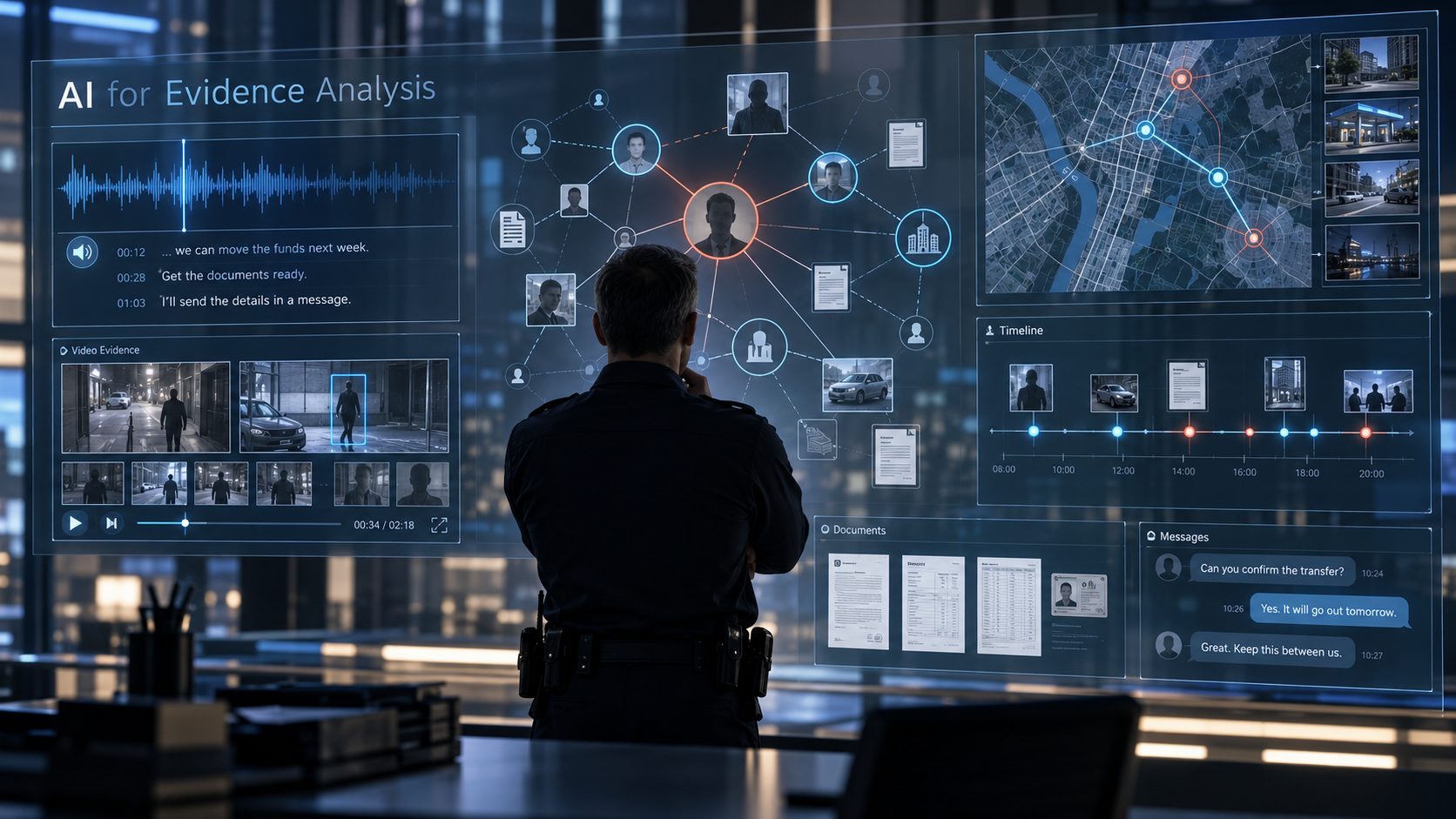
In less than 2 hours, the AI performed initial processing of the evidence, generated a relationship graph, reconstructed the chronology of events, and prepared excerpts from audio and video materials.
Additionally, the system used web searches to obtain publicly available information about the companies mentioned, their beneficial owners, and published financial statements.
Instead of a multitude of scattered files, the investigator received a structured overview of the investigation, with the ability to navigate directly from a found fact to its source.
Of course, two hours of automated processing cannot replace a legal assessment of the evidence or a full-scale investigation. But they demonstrate just how significantly the time spent searching for and organizing information can be reduced.
What exactly can AI automate?
1. Transcription of audio recordings
On-premises speech recognition systems, such as Whisper, Vosk, and their counterparts, allow audio recordings to be converted into text without having to send confidential materials to external cloud services.
Once transcribed, it becomes possible to search by names, dates, addresses, company names, monetary amounts, and key phrases. Each mention found can be accompanied by a timestamp and a link to the original recording.
Instead of having to listen to dozens of hours of audio again, an investigator can immediately jump to the relevant segment and review its content.
2. Real-Time Transcription of Hearings
Streaming speech recognition technologies allow for the generation of a text transcript directly during an interrogation or court hearing, provided such processing is permitted by applicable law.
In such cases, an authorized operator must be able to correct recognition errors in real time. The original audio recording and the revision history are preserved to ensure the result remains verifiable.
3. Video Analysis and Search for Relevant Footage
Computer vision makes it possible to automatically detect people, vehicles, and other objects, identify events of interest, and extract relevant video clips.
When analyzing footage from dozens or hundreds of cameras, algorithms can help track the presumed movements of objects between different observation points.
Such results require human verification: visual similarity alone does not prove that the same person or vehicle is present in different recordings.
4. Relationship Graph and Event Timeline
AI is capable of combining information from correspondence, audio recordings, video footage, and documents into a unified information structure.
This makes it possible to construct a graph of connections between people, companies, events, and financial transactions, as well as to create a timeline of the investigation linked to primary sources.
This approach is particularly useful in cases spanning several years and involving a large number of participants. The system helps identify connections without requiring the investigator to constantly keep hundreds of individual details in mind.
AI in Court Hearings: Real-Time Verification of Testimony
One of the most significant outcomes of the case described was the use of AI directly during court hearings.
The system analyzed the defendants’ oral statements and promptly cross-referenced them with a pre-processed body of evidence.
When a potential contradiction arose in the testimony, the AI identified related materials and allowed for a quick verification of the corresponding audio clips, correspondence, or documents.
For example, if a defendant denied having had contact with a specific person during a particular period, the system could find information indicating a possible discrepancy and display the source along with the date or timestamp.
Instead of a time-consuming manual search through the case files, the specialist received specific excerpts for immediate verification.
It is important to note that the AI’s task is not to determine whether a person is telling the truth or to establish their guilt. The algorithm is designed to detect potential contradictions and provide verifiable sources. The final assessment remains the responsibility of a human.
If we’ve automated vehicle monitoring, why not automate the analysis of evidence?
Automatic license plate recognition has long been used in traffic surveillance systems. Cameras capture vehicles, algorithms recognize license plates, and the information becomes available for searching and comparison.
Essentially, this is an example of transforming large volumes of visual data into structured information.
A similar principle applies to other types of digital evidence: audio recordings, videos, documents, and messages.
Instead of scattered files, the police can use a unified system in which each piece of material is indexed, linked to other sources, and made available for rapid analysis.
Of course, the processing of such data must comply with legislation, procedural requirements, and personal data protection regulations.
On-Premises AI: Confidentiality and Control Over Evidence
It is critically important for law enforcement agencies to maintain control over confidential materials. Therefore, modern solutions can be deployed directly on the organization’s own servers.
On-premises infrastructure allows for transcription, video analysis, document search, and the creation of relationship graphs without the need to transfer investigative materials to third-party cloud service providers.
At the same time, the system must ensure access control, activity logging, and the preservation of unaltered original evidence. Automatically generated transcripts, conclusions, and corrections must be stored separately from the source files.
External sources may be used to obtain publicly available corporate and financial data without disclosing confidential information about the investigation.
AI does not replace the investigator. It eliminates routine work
The goal of implementing artificial intelligence is not to delegate the authority to make legal decisions to algorithms.
AI should not independently determine guilt, the credibility of testimony, or the evidentiary significance of detected matches.
Its role is much more practical: to speed up information processing, locate relevant materials, reconstruct the chronology, and draw the specialist’s attention to circumstances requiring verification.
The case study shows that the preliminary organization of materials—a process that takes weeks or months to complete manually—can, under certain conditions, be accomplished in a matter of hours.
The future of digital investigation lies not in artificial intelligence replacing humans, but in specialists who, thanks to AI, have more time to analyze facts and make informed decisions.
Ready to automate your work with digital evidence?
PWN-ALL is ready to provide a solution tailored to the needs of your department or organization: from on-premises transcription of audio recordings and video analysis to building relationship graphs, event timelines, and intelligent searches of case materials.
We’re ready to discuss your requirements for infrastructure, confidentiality, access control, and integration with existing systems to offer a solution that fits your workflows.
Contact us to discuss your project and implementation options.